Law Firm Marketing Texas, Filed, Checked & Ready
Texas is one of the few states where many lawyer ads must be filed with the State Bar, and its barratry laws now reach social media messages. Law firm marketing Texas firms can rely on is built for those rules first, then planned metro by metro across a very large state.
- Every ad and page built to Rule 7.02, with the responsible lawyer and practice location named
- Planned for Advertising Review filing, so launches are not held up
- Real Spanish-language pages and intake for Texas’s border and metro markets
How Does Our Law Firm Marketing Texas Service Work?
Verdiqon helps Texas law firms grow through search, AI visibility and paid campaigns, working remotely. We do not claim a Texas office. Every plan starts with the Texas Disciplinary Rules, your metros and the practice areas you want to grow.
Verdiqon is an AI-powered growth agency built exclusively for law firms. Texas does things differently from most states: it has its own disciplinary rules, a formal ad filing system run by the State Bar and a criminal barratry statute that limits how firms may contact potential clients. A campaign copied from another state can stall in review or create real risk. So our law firm SEO, local search and ads for Texas are planned around Texas rules from day one, as part of our wider legal marketing in the USA.
Which Rules Govern Attorney Advertising in Texas?
Texas lawyer advertising is governed by Part VII of the Texas Disciplinary Rules of Professional Conduct, which was substantially rewritten effective July 1, 2021. Rules 7.01 to 7.06 cover what ads may say, what they must include and when they must be filed.
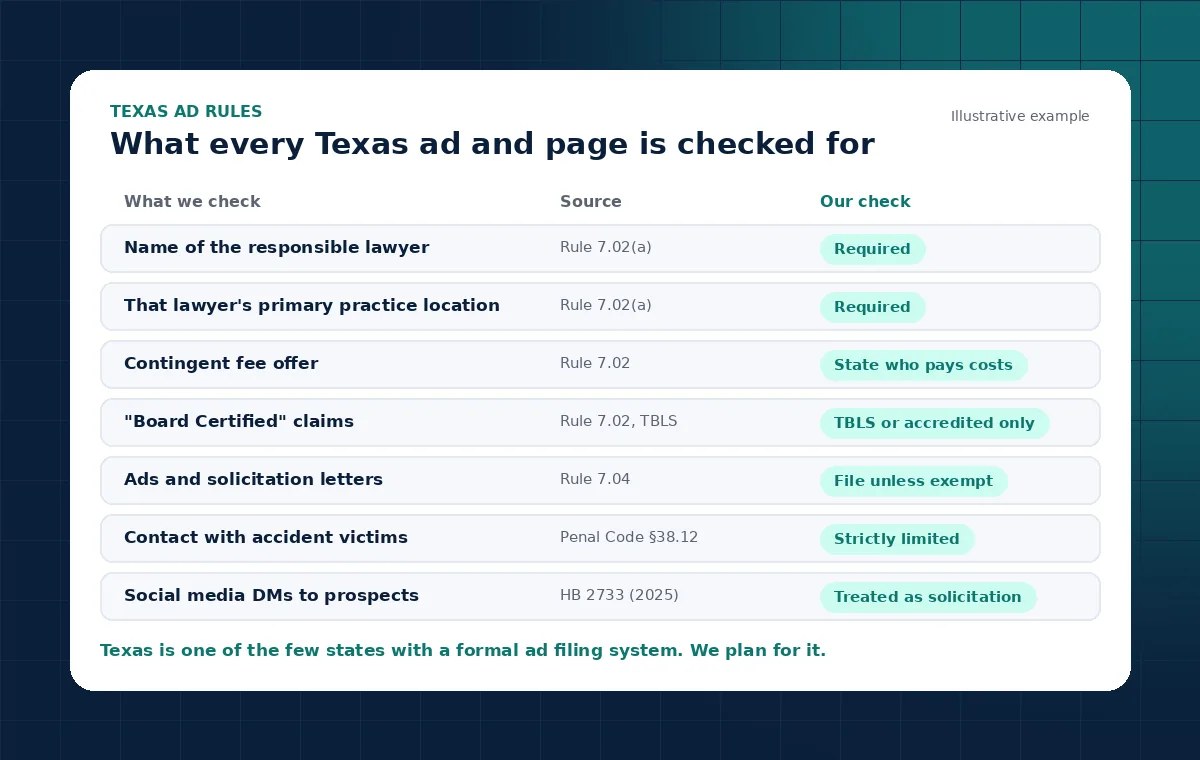
The main requirements that shape day-to-day marketing are set out in Rule 7.02:
- Responsible lawyer: an advertisement must publish the name of a lawyer responsible for its content.
- Practice location: the ad must identify that lawyer’s primary practice location.
- Contingent fees: an ad offering contingent-fee services must state whether the client will be responsible for other expenses, such as litigation costs.
- Board certification: a lawyer may say “Board Certified” only when certified by the Texas Board of Legal Specialization, or by an organization the Board has accredited, named in the claim.
Above all of this sits the general rule that communications about a lawyer’s services must not be false or misleading. The Supreme Court of Texas has also updated the guidance on advertising past results, so case results need careful wording and context.
This is general information, not legal advice. Your firm remains responsible for compliance, and we recommend reviewing the full rules.
Do Texas Lawyers Have to File Their Ads with the State Bar?
Often, yes. Under Rule 7.04, many advertisements and solicitation communications must be filed with the State Bar of Texas Advertising Review Committee unless an exemption applies, and failing to file a non-exempt ad is itself a rules violation.
The State Bar’s Advertising Review Department reviews filed ads and explains which content is exempt. Law firm websites can fall within the filing rules too, and the State Bar’s ethics resources address which parts of a site need to be filed. Firms can also ask for an advisory opinion before an ad runs. For marketing, this changes the timeline: new campaigns, landing pages and video ads need time for filing built into the plan. We prepare copy in a filing-ready format and keep a record of what ran and when, so your team can file without slowing the launch.
What Does the Texas Barratry Law Mean for Your Marketing?
Texas treats some unwanted solicitation as a crime. Penal Code §38.12 limits contacting accident victims and others who have not asked for help, and HB 2733, effective September 1, 2025, extended it to direct messages on social media and other electronic communications.
The statute restricts written and direct solicitation of people involved in an accident or disaster, particularly in the first 30 days, and the HB 2733 bill analysis explains that solicitation through social media DMs and other electronic channels is now expressly covered. For marketing, the safe approach is clear. Let clients find you, then respond fast. We focus on search, Maps, reviews and ads that people choose to click, and we never run outreach that messages potential clients who have not contacted your firm.
What Does Our Texas Law Firm Marketing Process Look Like?
Our Texas law firm marketing follows nine steps, from a rule review of your current materials to reporting signed cases. Each step is planned by metro and language, because Houston and Lubbock are very different markets.
Market & Rule Audit
We review your metros, competitors and how your firm appears in search and AI answers today.
Rule 7.02 Review
We check every page and ad for the responsible lawyer, location, cost disclosures and certification wording.
Filing-Ready Copy
Ads and landing pages prepared so your team can file with Advertising Review without delay.
Practice & Metro Pages
Practice pages with real local detail for each metro or county you serve.
Explore law firm SEO ↗Map Pack by Metro
Google Business Profiles for real, staffed offices and steady, honest reviews.
Explore local SEO ↗Spanish-Language Pages
Real Spanish pages and intake for border and metro markets, held to the same rules.
Rule-Checked Google Ads
Campaigns split by metro, with copy written for Texas rules.
Explore Google Ads ↗Fast Intake
Quick response to people who contact you, without crossing into solicitation.
Explore lead generation ↗Case Reporting
We report calls, consultations and signed cases by metro, practice and source.
How Do Texas Legal Markets Differ?
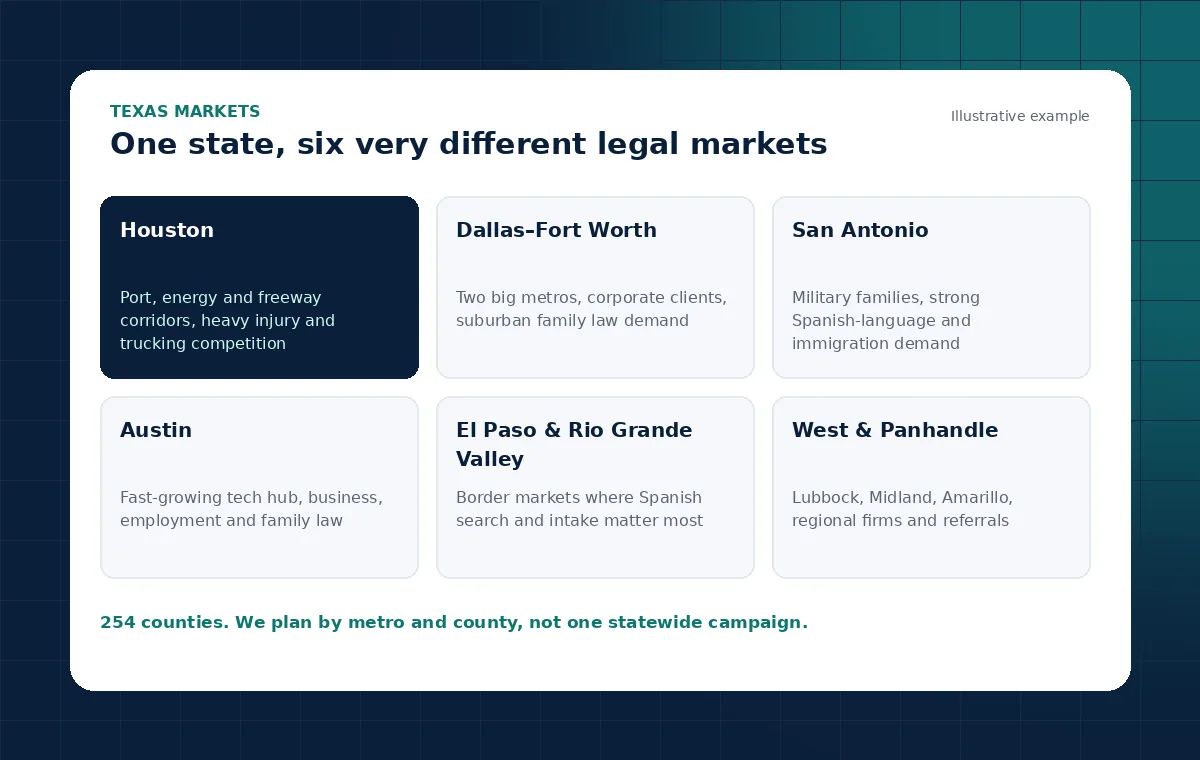
Texas is several large legal markets in one state. Houston is one of the most competitive injury markets in the country, shaped by freeways, the port and the energy industry, where trucking and workplace accident terms are heavily contested. Dallas–Fort Worth combines two major metros with corporate clients, fast-growing suburbs and strong family law demand. San Antonio adds military families and a large Spanish-speaking population, Austin brings tech employers and business clients, and El Paso and the Rio Grande Valley are border markets where Spanish search and Spanish intake can decide who gets the call. Local language matters too: Texans search for “DWI” rather than “DUI”, and Texas cases run through district courts and county courts at law across 254 counties. We plan pages, profiles and campaigns for each market rather than one statewide approach.
Which SEO Moves Matter Most for Texas Law Firms?
Six moves usually make the biggest difference for Texas firms in search, from metro-level pages to Spanish content and accurate certification wording.
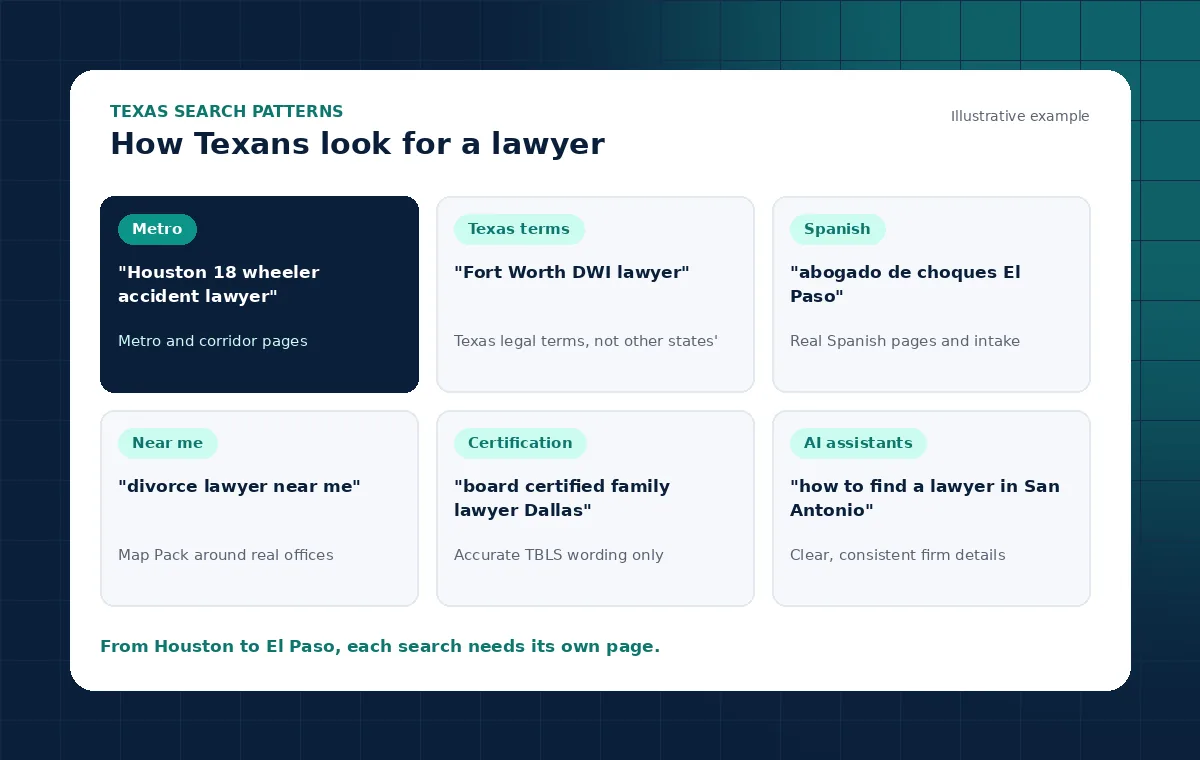
Build pages metro by metro
A Houston trucking page and a Fort Worth DWI page should each reflect local roads, courts and communities. Generic pages with a city swapped in rarely rank and can look like doorway pages.
Win the Map Pack around real offices
Complete Google Business Profiles for each staffed office, never virtual addresses. Our local SEO for lawyers follows Google’s guidelines.
Use Texas legal language
DWI, district courts, county courts at law and Texas-specific procedures. Content that uses another state’s terms signals that it was not written for Texas clients.
Write Spanish content properly
Spanish pages are still advertising and need the same disclosures. Matched with Spanish intake, they can reach clients competitors miss. See our immigration lawyer marketing.
Use “Board Certified” accurately
Only lawyers certified by the Texas Board of Legal Specialization or an accredited body may claim it, in the approved form. We check every profile and page.
Prepare for AI answers
Answer-first guides and consistent firm details help you appear in AI Overviews and assistant answers through answer engine optimization.
Which Practice Areas Do We Support in Texas?
As a law firm marketing agency for Texas firms, we support six core practice areas. Each has its own search patterns, rules risks and client expectations in Texas.
Personal injury
Trucking, oilfield and car accident terms are among the most contested in Texas, and the barratry limits make inbound marketing essential. See our personal injury marketing.
Family law
Divorce, custody and support content written for Texas courts, with discreet contact options. See our family law marketing.
Immigration
English and Spanish pages with visible credentials, from San Antonio to the border. See our immigration lawyer marketing.
Criminal defense
County-specific DWI and defense pages with after-hours response. See our criminal defense marketing.
Estate planning
Wills, trusts and probate guides for Texas families, from Austin to the Panhandle. See our estate planning marketing.
Business law
B2B buyers in Dallas, Houston and Austin, partner insights and AI shortlists. See our business law firm marketing.
What Else Should Texas Firms Check Before Advertising?
Four issues often catch Texas firms out: filing deadlines, outbound messaging, paid lead services and past-results claims.
Have new ads been filed?
Many new ads and solicitation communications must be filed under Rule 7.04 unless exempt. We build filing time into every launch plan.
Is your team sending DMs to prospects?
Since HB 2733, solicitation through social media DMs and other electronic messages is expressly covered by the barratry statute. Inbound marketing is the safer path.
Can you pay for leads?
Payments for referrals are restricted under the Texas rules. Lead and marketing arrangements should be reviewed carefully before you sign.
Should Texas firms use Local Services Ads?
Often, yes. Google offers Local Services Ads for many legal categories, and they work best alongside strong local profiles and fast response.
General information only, not legal advice. Rules change over time, so your firm remains responsible for compliance.
Why Choose Verdiqon for Law Firm Marketing in Texas?
Verdiqon offers law firm marketing Texas firms can rely on, built for law firms only. We work from Texas rules, plan for filing and inbound-only outreach, and measure success by signed cases rather than clicks.
Built for Texas Rules
Every page and ad checked against Rule 7.02 and the certification rules.
Filing-Ready Campaigns
Copy prepared for Advertising Review, with records of what ran and when.
Planned by Metro
Houston, Dallas–Fort Worth, San Antonio, Austin and the border treated as their own markets.
Spanish That Is Truly Reviewed
Real Spanish pages and intake, held to the same rules as English.
Inbound, Never Barratry
No cold DMs or outreach to people who have not contacted you.
Measured by Signed Cases
Reporting by metro, practice and source, not vanity metrics.
Frequently Asked Questions
Do you have an office in Texas?
We work with Texas law firms remotely and do not claim a Texas office. We meet by video call and plan around Texas rules and markets.
Which rules govern attorney advertising in Texas?
Part VII of the Texas Disciplinary Rules of Professional Conduct, Rules 7.01 to 7.06, rewritten effective July 1, 2021. Penal Code §38.12 also limits solicitation of potential clients.
Do Texas lawyers have to file their ads?
Many advertisements and solicitation communications must be filed with the State Bar of Texas Advertising Review Committee under Rule 7.04 unless an exemption applies. Failing to file a non-exempt ad is a rules violation.
What must a Texas lawyer ad include?
Under Rule 7.02, it must name a lawyer responsible for its content and identify that lawyer’s primary practice location. Ads offering contingent fees must also say whether clients pay other expenses, such as litigation costs.
Can a Texas lawyer say they are board certified?
Only if certified by the Texas Board of Legal Specialization or an organization it has accredited, using the approved wording and naming the certifying body.
Can law firms message potential clients on social media in Texas?
Contacting people who have not sought your services can amount to barratry. HB 2733, effective September 1, 2025, expressly added social media direct messages and other electronic communications to the statute.
Which services do Texas firms usually start with?
Most start with a free audit and a rule review of their site, then law firm SEO and local SEO by metro, adding Spanish pages and Google Ads in competitive practice areas.